
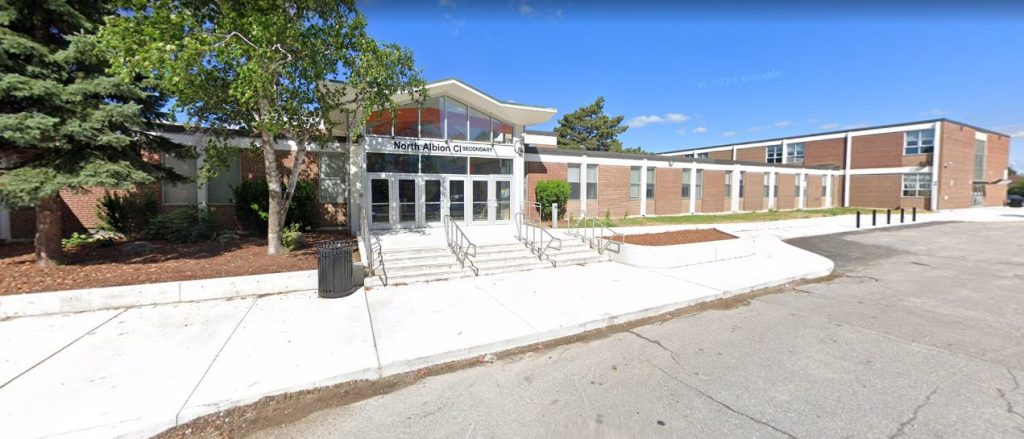
Established in 1962, North Albion Collegiate Institute has earned its place as one of Toronto’s most dynamic and inclusive public high schools. Located in the heart of Rexdale in northwest Toronto’s Etobicoke borough, NACI serves as a vibrant educational hub for the multicultural community it represents. With its mission to empower students to become dynamic citizens through excellence, service, and truth, the school continues to build on decades of academic and athletic achievement.
North Albion distinguishes itself through its commitment to diversity and inclusion, with over 50 languages spoken by its approximately 827 students. This multilingual student body creates a truly global village atmosphere, fostering cross-cultural understanding and collaboration. Beyond academics, the school promotes positive student leadership through student-driven co-curricular activities and maintains a strong focus on equity, well-being, and overall student success. With a historic commitment to innovation—notably being the first school in North America to offer Steel Band as a full credit course in high school—North Albion continues to set benchmarks for comprehensive secondary education.
The school’s recent Ontario Secondary School Literacy Test (OSSLT) results reflect solid academic performance, with 81% of first-time eligible Grade 10 students achieving or exceeding the provincial standard in literacy, compared to 19% below standard. This demonstrates the effectiveness of NACI’s academic support systems and comprehensive curriculum.
Basic Details

| Category | Details |
|---|---|
| School Name | North Albion Collegiate Institute |
| Year Founded | 1962 |
| School Type | Public |
| Gender | Co-educational |
| Grade Levels Offered | 9–12 |
| Enrollment | ~827 students (as of 2024) |
| Building Capacity | ~1,095 students |
| Motto | Virtus, Officium, Veritas (Excellence, Service, Truth) |
| Location | 2580 Kipling Avenue, Etobicoke, ON M9V 3B2 |
Unique Information About the School

North Albion CI made history by being the first school in North America to offer Steel Band as a full credit high school course, reflecting its pioneering approach to arts education. The school’s Teacher Advisor Program is an integral part of NACI’s structure, providing multi-grade, whole-school support to foster student development.
The school community’s commitment to service is demonstrated through active participation in student government, parent councils, leadership clubs, breakfast clubs, community beautification initiatives, and partnerships with organizations like the United Way, World Vision Volunteers, and Crime Stoppers. Additionally, North Albion stands out as a global village where cultural diversity is celebrated and students from across the world represent their traditions and values.
2. Socio-Demographic Context and Community Integration
2.1 Demographic Composition and Linguistic Diversity
The demographic profile of North Albion Collegiate Institute presents a distinct set of challenges and opportunities that differ markedly from the provincial averages of Ontario. The student body is characterized by a high degree of linguistic and cultural diversity, which fundamentally shapes the pedagogical approach of the institution.
Data from educational profiles indicates that approximately 52% of NACI students identify as having a first language other than English. This figure stands in stark contrast to the provincial average of 24.7%, highlighting the school’s role as a primary educational frontier for linguistic integration. Furthermore, 16% of the student population is composed of students who are new to Canada from non-English speaking countries, a rate that is more than double the provincial average of 7.1%.
| Demographic Indicator | NACI Percentage | Provincial Average | Implication for Educational Delivery |
| First Language Not English | 52% | 24.7% | High demand for ESL/ELL programming and culturally responsive literacy interventions. |
| New to Canada (Non-English) | 16% | 7.1% | Need for robust settlement support services and trauma-informed intake processes. |
| New to Canada (Non-French) | 16% | 7.6% | Similar implications for general adaptation to the Canadian school system. |
| First Language Not French | 99% | 96.4% | Indicates a predominantly Anglophone or Allophone integration context. |
These statistics suggest that a significant portion of the school’s resources must be dedicated to English Language Learning (ELL) support. The high concentration of newcomers necessitates that teachers possess specialized training in language acquisition and cultural adaptation. The school’s identity as a “Global Village” is thus a direct reflection of this statistical reality, serving communities from South Asia, the Caribbean, Africa, and the Middle East.
2.2 Socio-Economic Stratification and Resource Allocation
NACI operates within a socio-economic context that requires targeted intervention strategies to ensure equitable outcomes. The Rexdale community, while culturally rich, faces distinct economic headwinds that are reflected in the school’s demographic data.
- Low-Income Households: Approximately 15% of school-aged children in the NACI catchment area live in lower-income households, compared to the provincial average of 9.3%. This economic disparity often correlates with barriers to accessing educational resources outside of school, such as private tutoring or extracurricular enrichment.
- Parental Education: 20% of students come from households where parents do not have a certificate, diploma, or degree, significantly higher than the provincial average of 4.9%. This suggests that a fifth of the student body may be first-generation graduates, lacking the intergenerational academic capital that facilitates navigation of the secondary and post-secondary systems.
- Special Education Needs: The school supports a higher-than-average population of students receiving special education services (19% vs. 16.1% provincially). This necessitates a robust special education department capable of delivering Individual Education Plans (IEPs) and differentiated instruction effectively.
These socio-economic indicators underscore the critical function of NACI as an engine of social mobility. The school must provide not only academic instruction but also the social and cultural capital—through mentorship, guidance, and experiential learning—that might otherwise be inaccessible to its students. The reported “limited funding” and challenges with “access to essential resources” noted in community reviews are likely exacerbated by these systemic pressures, making efficient resource utilization a priority for the administration.
3. Academic Architecture and Pedagogical Frameworks
3.1 Curriculum Design and Instructional Philosophy
The academic framework at NACI is designed to accommodate a wide spectrum of learner needs, from university-bound scholars to students pursuing apprenticeships and direct workplace entry. The curriculum is delivered on a semestered schedule, which allows for focused study and faster credit accumulation, a model often beneficial for students requiring credit recovery or acceleration.
The teaching faculty is described as a “dynamic team of highly qualified, dedicated teachers” who are committed to using the latest technology in the classroom. This commitment is critical in a school where digital literacy can serve as a powerful equalizer. The instructional philosophy emphasizes “innovative opportunities” to support student growth, moving beyond rote memorization to foster critical thinking and problem-solving skills. Teachers like Eryn Decoste, a recipient of the BookLove grant, exemplify this dedication to literacy, actively securing external funding to build classroom libraries that reflect the diverse identities of the students, thereby enhancing engagement and reading proficiency. Similarly, Nikita Boodoo, a recipient of the OTIP Teaching Award, represents the new generation of educators at NACI who foster strong relational trust with students, a key factor in academic success in high-needs environments.
3.2 Centre of Excellence for Black Student Achievement
A pivotal component of NACI’s academic and social architecture is its alignment with the Centre of Excellence for Black Student Achievement. As a TDSB initiative, the Centre works to dismantle anti-Black racism and improve outcomes for Black students, a demographic significantly represented at NACI.
This partnership involves:
- Curriculum Responsiveness: Integrating Black narratives and history into the standard curriculum to ensure representation.
- Leadership Pathways: Programs like the Black Student Summer Leadership Program (“From the Village to the Vision”) provide mentorship and leadership development, empowering students to take on active roles in their school and community.
- Family Engagement: Events such as “Navigating the Specialized Programs Process for Families Raising Black Children” are critical for closing the information gap and ensuring that Black families can equitable access specialized streams like SHSM and STEM.
The integration of the Centre’s mandates into NACI’s daily operations signifies a move towards targeted universalism—improving outcomes for the most marginalized groups to lift the performance of the entire school system.
4. Specialized Pathways: SHSM and STEM
North Albion Collegiate Institute has distinguished itself through the implementation of specialized programs that provide direct, high-quality pathways to post-secondary success. These programs are designed to engage students by connecting classroom learning to real-world economic sectors.
4.1 Specialist High Skills Major (SHSM) in Business
The Specialist High Skills Major (SHSM) is a Ministry of Education-approved program that allows students to customize their high school experience to fit their career interests. NACI’s Business SHSM is particularly notable as the first of its kind in the school’s Learning Network.
Program Architecture: The SHSM in Business is a comprehensive two-year program (Grades 11 and 12) comprising five mandatory components :
- Bundle of Credits: Students must complete nine specific credits:
- 4 Major Credits: Focused on business studies (e.g., marketing, accounting, entrepreneurship).
- 3 Other Required Credits: Including English and Mathematics, contextualized to the business sector.
- 2 Cooperative Education Credits: Providing hands-on workplace experience.
- Certifications: Students earn industry-recognized certifications (e.g., customer service, first aid, project management), enhancing their resume before graduation.
- Experiential Learning: Activities involving observation and participation in the business sector.
- Reach Ahead Experiences: Opportunities to visit colleges and universities, helping students visualize their post-secondary future.
- Sector-Partnered Experiences (SPE): Activities focused on Innovation, Creativity, and Entrepreneurship (ICE), where students solve real-world problems presented by industry partners.
Strategic Value: This program is available to students in all pathways (Apprenticeship, College, University, Workplace), ensuring inclusivity. By offering this at no cost, NACI removes financial barriers to enriched education. The Business SHSM allows students to develop specialized skills in entrepreneurship and finance, which are highly valued in the modern economy, effectively de-risking the transition from school to work.
4.2 STEM@NACI: The MST (Math, Science, Technology) Local Program
Recognizing the increasing demand for literacy in science and technology, NACI developed STEM@NACI, a localized Math, Science, and Technology (MST) program. This initiative is designed to foster a culture of innovation and inquiry.
Pedagogical Model:
- Cohorted Learning: A key feature is the cohort model, where Grade 9 and 10 students take their science and technology classes together. This builds a “community of practice” where students with shared interests can support one another, reducing isolation and fostering peer-to-peer learning.
- Interdisciplinary Integration: The program integrates hands-on technological kits into science classes, bridging the gap between theoretical concepts and practical application. This approach is essential for engaging students who learn best through kinesthetic methods.
- Entrepreneurial Focus: Unique to NACI is the encouragement for STEM students to also engage with the Business SHSM. This cross-pollination prepares students not just to be technicians, but to be innovators and entrepreneurs capable of commercializing their ideas.
- Future Proofing: As students progress to Grade 12, course options expand to support various post-secondary pathways, ensuring that the STEM foundation leads to tangible outcomes in higher education or the trades.
4.3 Dual Credit Partnerships and Humber College Collaboration
To further bridge the gap to post-secondary education, NACI has established robust Dual Credit partnerships with local institutions like Humber College and the University of Guelph-Humber.
Mechanism and Impact: These programs allow students to take college-level courses while still in high school, earning credits that count towards both their Ontario Secondary School Diploma (OSSD) and a college certificate or diploma.
- Risk Mitigation: For students who may be the first in their family to attend college (a significant portion of NACI’s demographic), these courses demystify the higher education environment. Students learn to navigate college campuses and expectations with the safety net of high school support.
- Financial Accessibility: Dual credit courses are typically fully funded, providing students with free college credits and reducing the future cost of their education.
- Broadened Horizons: The partnership exposes students to a variety of fields and campus life experiences that they might not otherwise encounter, fostering higher aspirations and clearer career goals.
5. Co-Curricular Engagement and Cultural Heritage
Education at NACI extends well beyond the classroom walls. The school’s co-curricular program is a vital instrument for student engagement, mental health support, and cultural validation.
5.1 The Steel Pan Legacy: A Cultural Cornerstone
NACI holds a distinguished place in the history of music education in North America. It was the first school in North America to offer a steel pan band as a full-credit course, a pioneering move initiated in 1984.
Historical Significance: The program was spearheaded by “Panman Pat” McNeilly, a renowned educator and musician who introduced the steel pan curriculum to the Etobicoke Board of Education. Recognizing the significant Caribbean population in the Rexdale area, McNeilly utilized the steel pan not just as a musical instrument, but as a tool for cultural affirmation. By validating the cultural heritage of his students within the formal curriculum, he engaged students who might otherwise have felt alienated by a Eurocentric music program.
Current Status: Today, the Music Department continues this legacy, offering courses in keyboards and steel pan. The “Steel Pan Band” remains a vibrant club and course, frequently cited by students as a source of confidence and school spirit. This program is a prime example of Culturally Responsive and Relevant Pedagogy (CRRP) in action, decades before the term became standard in educational policy.
5.2 Athletics: The “Home of the Cougars”
Athletics serve as a major pillar of school culture at NACI. The school fields competitive teams in a variety of sports, with particular strengths reflecting the interests of its diverse student body.
- Cricket: The school boasts a notable cricket team, catering to the strong South Asian and Caribbean communities in Rexdale. This inclusion allows students to excel in a sport that is culturally significant to them, fostering a sense of belonging.
- Traditional Sports: NACI teams regularly compete in volleyball, basketball, soccer, softball, and Ultimate Frisbee.
- Individual Excellence: The athletics program has produced elite athletes such as Busola Akinduro, a track and field star who set records at OFSAA and national competitions and was scouted by the University of California, Berkeley. Her success demonstrates the high caliber of athletic coaching and talent development available at the school.
5.3 Clubs and Student Leadership
Student leadership is promoted through a wide array of clubs that cater to diverse interests and skill sets.
- Robotics (Team 2935): The NACI Robotics team allows students to apply STEM learning in a competitive environment, fostering engineering and coding skills.
- Cultural and Social Clubs: Options like Bollywood Dancing, Chess Club, and the Announcement Team provide outlets for creative expression and social interaction.
- Academic and Professional Clubs: The DECA chapter and Model UN team prepare students for business and political leadership, honing their public speaking and negotiation skills.
- Tech Crew: Students involved in the Tech Crew gain practical experience in event production, managing the lighting and sound for school assemblies in the 750-seat auditorium.
These activities are essential for building “social capital”—the networks and social skills that facilitate upward mobility. As one student review noted, “There are many clubs at NACI which help me become more confident and outgoing”.
6. Institutional Safety, Resilience, and Strategic Partnerships
NACI’s operational reality includes managing the complexities of safety in an urban priority neighbourhood. The school has faced significant challenges but has responded with robust systemic interventions.
6.1 Critical Incidents and Resilience
The school community has shown remarkable resilience in the face of tragedy.
- September 2014 Incident: The fatal stabbing of 19-year-old student Hamid Aminzada in a school hallway was a traumatic event for the community. Aminzada, who was intervening to defuse a fight between other students, is remembered for his bravery. This incident catalyzed a deeper conversation about youth violence and school safety in Toronto.
- June 2024 Incident: A shooting occurred outside the school near Kipling Avenue and Mount Olive Drive, resulting in a fatality and injuries. Although this event transpired on the periphery of the school grounds, it reinforced the need for continuous vigilance and community-level interventions.
6.2 Systemic Safety Interventions: FOCUS Rexdale
In response to safety concerns, NACI has moved beyond simple security measures to adopt a holistic, community-integrated safety model. The school is a key stakeholder in FOCUS Rexdale (Furthering Our Communities’ United Services).
The Situation Table Model: FOCUS Rexdale utilizes a “Situation Table” approach, where representatives from the police, social services, health agencies, and education (including NACI administration) meet weekly.
- Mechanism: The table identifies individuals or families at “acutely elevated risk” of harm or victimization.
- Intervention: Relevant agencies are deployed to provide immediate, coordinated support (e.g., housing, mental health counselling, mentorship) to de-escalate the risk before it results in a police call or violent incident.
- School Role: NACI participates actively, with staff empowered to refer situations to the table. This shifts the paradigm from “punishing” at-risk students to “supporting” them through multi-agency collaboration.
6.3 Safe and Caring Schools Initiatives
Internally, NACI adheres to the Safe and Caring Schools policy framework.
- Partnerships: The school collaborates with professional support services, equity departments, and community organizations to create a welcoming environment.
- Conflict Resolution: There is an emphasis on progressive discipline and restorative justice practices to address behaviour while keeping students engaged in education.
- External Partners: Collaborations with organizations like P.E.A.C.H. (Promoting Economic Action and Community Health) and The Randolph School (a support program for expelled students) ensure that even the most vulnerable students have pathways back to success.
7. Performance Metrics, Assessment, and Public Perception
Evaluating the performance of North Albion Collegiate Institute requires a nuanced understanding of data, distinguishing between standardized snapshots and longitudinal student growth.
7.1 Standardized Testing and Rankings
In the 2024 Fraser Institute rankings, NACI was assigned a score of 4.3 out of 10, placing it 617th out of 746 secondary schools in Ontario. These rankings are largely derived from EQAO (Education Quality and Accountability Office) test results in literacy and mathematics.
Critical Analysis of the Data:
- Linguistic Bias: Standardized tests in Ontario are administered in English. With 52% of NACI students being English Language Learners (ELL) and 16% being recent newcomers, raw test scores often reflect language proficiency rather than intellectual capability. A student brilliant in mathematics but new to English may score poorly on a word-heavy math problem, depressing the school’s overall ranking.
- Socio-Economic Correlation: Educational research consistently demonstrates a strong correlation between standardized test scores and household income. Given NACI’s lower-income demographic (15% below the poverty line), the rankings are arguably a reflection of systemic inequity rather than teaching quality.
- Community Rebuttal: Public sentiment, such as discussions on Reddit, often dismisses these rankings as a “load of crap,” arguing that they fail to capture the value of schools that serve complex populations.
7.2 Qualitative Assessment and “Value-Added”
Contrasting with the quantitative data, qualitative reviews paint a picture of a high-functioning, supportive institution.
- Teacher Quality: Online reviews on platforms like Wheree.com consistently praise the “dedicated teachers” who inspire students, specifically highlighting the technology and graphic design departments.
- Student Satisfaction: Students report feeling supported by staff who are “always there when we need someone to talk to,” indicating a strong culture of care.
- Areas for Improvement: Constructive criticism notes “limited funding” impacting sports equipment and a need for more creativity in student council events, reflecting the resource constraints common in the public sector.
The “Value-Added” Perspective: While the absolute test scores may be low, the relative progress of students is often high. The school effectively takes students with significant barriers (language, poverty, trauma) and guides them to graduation and post-secondary acceptance. The success of alumni at elite institutions suggests that for students who engage with the available resources, NACI provides a world-class launching pad.
8. Distinguished Alumni and Student Success Narratives
The ultimate measure of a school’s efficacy is the quality of its graduates. NACI has an impressive track record of producing leaders in arts, athletics, and academia, validating its educational model.
8.1 Recent Success Stories
- Azim Raheem (Class of 2020): A standout example of NACI’s academic and athletic rigor. Raheem was recruited by Harvard University for their volleyball team, a rare feat for a Canadian public school student. His journey from Rexdale to the Ivy League illustrates that NACI can support the highest levels of ambition. Raheem credited the “small impacts” of the people around him at NACI for his success.
- Busola Akinduro (Class of 2019): A track and field phenomenon who leveraged her athletic training at NACI to secure interest from the University of California, Berkeley. Her success highlights the school’s ability to facilitate NCAA-level opportunities for its athletes.
8.2 Notable Alumni in Arts and Media
The school’s arts programs have nurtured significant creative talent:
- Bruce McDonald: A highly influential Canadian film director (Highway 61, Hard Core Logo, The Tracey Fragments), whose work often explores counter-cultural themes.
- Teri Austin: Actress known for her roles in television and film.
- Dean McDermott: Actor and reality television personality.
- Johnny Legend: Stand-up comedian, actor, and radio host.
8.3 Leaders in Sport and Science
- John L. Wallace: A medical researcher and Fellow of the Royal Society of Canada. He co-founded NicOx and founded Antibe Therapeutics, demonstrating the strength of the science foundation provided at NACI.
- Daniel Dearing: An Olympian in beach volleyball, representing Canada on the world stage.
- Andrés Fresenga: Professional soccer player with the Ottawa Fury FC.
- Craig Ramsay: Former NHL player and coach, representing the school’s long history of hockey excellence.
Note: Care has been taken to distinguish these alumni from graduates of Albion College in Michigan, ensuring all listed individuals are verified graduates of North Albion Collegiate Institute in Toronto.
9. Conclusion
North Albion Collegiate Institute represents a complex but ultimately triumphant case study in urban public education. Situated at the intersection of high diversity and socio-economic challenge, the school has refused to be defined by its constraints. Instead, it has leveraged its identity as a “Global Village” to create a unique educational environment that values resilience, cultural heritage, and practical innovation.
Structurally, NACI has adapted to the needs of the 21st-century economy through the aggressive implementation of specialized programs. The SHSM in Business and STEM@NACI pathways provide students with tangible skills and certifications that bridge the gap between secondary school and the workforce. The Dual Credit partnerships with Humber College further dismantle barriers to higher education, making the “impossible” accessible for first-generation learners.
Culturally, the school is a pioneer. The Steel Pan program stands as a decades-long testament to the power of inclusive curriculum, while the Centre of Excellence for Black Student Achievement ensures that the institution remains at the forefront of equity work in the TDSB.
While the Fraser Institute rankings present a statistical challenge, they fail to capture the “value-added” by the school’s dedicated staff. The discrepancy between these low rankings and the high achievements of alumni—from Harvard scholars to Olympians—suggests that NACI is a place where potential is nurtured regardless of starting point.
Ongoing challenges regarding safety and funding are real, but the school’s integration into the FOCUS Rexdale model demonstrates a sophisticated, community-first approach to security. By treating safety as a product of community well-being rather than just enforcement, NACI positions itself as a stabilizing force in Rexdale.
In summary, North Albion Collegiate Institute functions not merely as a school, but as a vital community hub that processes the raw potential of a diverse immigrant population and refines it into the “dynamic citizens” envisioned in its mission statement. It is an institution that embodies its motto: Excellence in its innovative programming, Service in its community integration, and Truth in its commitment to equity.